GPTZero is one of the most widely used AI detectors in the world. Teachers, universities, employers, and publishers use it to check whether writing was generated by ChatGPT, Claude, Gemini, or other AI models.
It's also one of the hardest detectors to get past. GPTZero updates its model constantly, and many tricks that worked a few months ago no longer do.
This guide covers:
- How GPTZero detects AI writing
- GPTZero's latest model updates
- How accurate GPTZero really is
- What doesn't work to bypass GPTZero
- What actually works, step by step
🎯 How GPTZero Works
GPTZero doesn't check for plagiarism. It looks for the statistical patterns that large language models leave behind.
Here's what it analyzes:
- Perplexity: how predictable each word is. AI models tend to choose common, high-probability words, so AI text scores low.
- Burstiness: how much sentence length and structure vary. Human writing mixes short and long sentences; AI writing is often uniform.
- Structure: consistent tone, overused transitions like "Furthermore" and "In conclusion," and a smooth, robotic flow.
- Syntax patterns: how phrases and sentences are built, compared against large datasets of human and AI writing.
GPTZero then gives the text an overall score and classifies it as AI-generated, Mixed, or Human, with sentence-level highlighting that shows which parts it thinks are AI.
It also includes paraphraser and AI bypasser detection, which is designed to catch text that was run through tools like QuillBot or basic humanizers.
🔄 GPTZero's Latest Updates
GPTZero releases new detection models constantly, often every month. Each update aims to catch newer AI models and more humanizer tricks, while reducing false positives.
2026 Updates
| Date | Model | What Changed |
|---|---|---|
| September 2026 | 4.10b (also called 4o) | Lower false positive rate across a variety of writing domains |
| August 2026 | 4.9b | Better detection of newer models, including Claude 5, GPT 5.6, Gemini 3.6, and Grok 4.5 |
| August 2026 | 4.8b | Headers are now excluded from the text GPTZero analyzes |
| July 2026 | 4.7b | Improved performance on academic writing, fewer false positives, more consistent advanced scans |
| May 2026 | 4.6b | Data balance adjustments |
How It Started: 2025
The rapid pace isn't new. In 2025, GPTZero released five models in about three months:
- June 3 (3.5b): detection of lightly "polished" AI text and stronger resistance to bypassers
- July 23 (3.6b): fewer false positives, better handling of special characters, tougher on bypassers
- August 11 (3.7b): improved against new LLMs and adversarial prompts
- August 22 (3.8b): optimized for GPT-5 content
- September 4 (3.9b): accuracy improvements across the board
GPTZero documents every update in its public release notes. The takeaway: any method for bypassing GPTZero has to keep up with a detector that changes every few weeks.
🔍 How Accurate Is GPTZero?
GPTZero is very effective at detecting unedited AI text from ChatGPT, Claude, Gemini, and other models, especially in:
- Long-form essays
- Academic papers
- Formal explanations and reports
But it isn't perfect. GPTZero can produce false positives, flagging genuine human writing as AI, especially when writing is very formal, simple, or polished. Research has shown that AI detectors flag non-native English writers far more often, and GPTZero's own recent updates have focused on reducing false positives.
For a deeper look, see our breakdown of whether GPTZero is accurate and our ZeroGPT vs GPTZero comparison.
❌ What Doesn't Work to Bypass GPTZero
Many popular tricks no longer work against GPTZero's current models:
- Synonym swapping: replacing words keeps the same predictable structure, so perplexity and burstiness barely change.
- Paraphrasers like QuillBot: GPTZero specifically detects paraphrased AI text. In our tests, QuillBot output still scored 100% AI.
- "Write like a human" prompts: asking ChatGPT to sound more human usually just produces a different version of AI writing.
- Adding typos or odd characters: GPTZero handles special characters and minor errors, and it makes your writing look worse.
- Translating back and forth: running text through another language and back tends to damage meaning without reliably lowering scores.
- Basic humanizers: many humanizers only reword text on the surface, which GPTZero's bypasser detection is built to catch. Our tests of whether GPTZero detects AI humanizers show most still get flagged.
✅ What Actually Works: AI Humanizers
The most reliable way to bypass GPTZero is an AI humanizer. Manual edits and simple tricks leave behind the patterns GPTZero measures, but a good humanizer rewrites text at a deeper level, so the result reads like it was written by a person.
Why AI Humanizers Work
GPTZero flags text based on its patterns: predictable word choice, uniform sentence length, and robotic structure. Paraphrasers only swap words, so those patterns stay the same. An AI humanizer changes the patterns themselves:
- Restructures sentences instead of just replacing words
- Varies sentence length and rhythm, raising the burstiness GPTZero looks for
- Removes common AI phrasing like repetitive transitions and filler
- Keeps your original meaning, so the content stays accurate
What to Look for in an AI Humanizer
Not every humanizer can handle GPTZero's latest models. The best ones:
- Keep up with GPTZero's updates, since GPTZero releases new models almost every month
- Pass multiple detectors, not just one, including GPTZero, Turnitin, and ZeroGPT
- Produce natural, readable writing, not awkward or broken sentences
- Include a built-in AI detector, so you can check results right away
Verva's AI humanizer is built for exactly this, and in our tests it consistently passed GPTZero.
How to Humanize Text for GPTZero
- Paste your AI-generated text from ChatGPT, Claude, Gemini, or any other model into the humanizer.
- Humanize it and read the result to make sure it still says what you mean.
- Add a personal touch if you like, such as your own examples or opinions.
- Check it with an AI detector, like the free Verva AI detector or GPTZero's free plan, before you submit.
Extra Tips
These help on their own, and even more alongside a humanizer:
- Cut common AI phrases like "Furthermore," "It's important to note," and "delve." See our list of common AI words and phrases.
- Add specific details, such as real examples, numbers, and personal experience, which are hard for AI to produce.
- Don't rely on manual editing alone. It helps, but it often isn't enough to pass GPTZero, since the underlying AI patterns can remain.
🧪 Our GPTZero Test
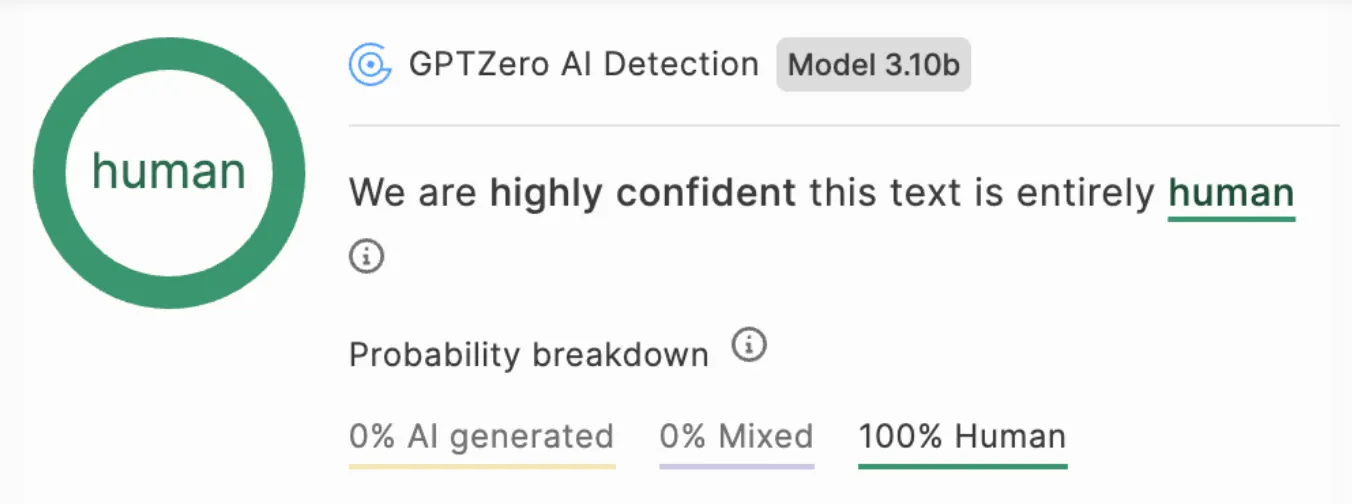
We tested GPT-5 essays, emails, and blog posts in GPTZero before and after humanizing them with Verva.
| Text | GPTZero Result |
|---|---|
| Original GPT-5 text | 100% AI |
| After Verva | 0% AI |
Even against GPTZero's newer models, the humanized text was classified as human.
📌 FAQ
Can GPTZero detect humanized text?
GPTZero can detect paraphrased text and many basic humanizers, since its models include bypasser detection. Text that has been deeply rewritten, either manually or with a strong humanizer, is much harder for it to flag.
Can GPTZero detect QuillBot?
Yes. GPTZero is built to detect paraphrased AI writing, and QuillBot output still scored 100% AI in our tests.
What is GPTZero's latest model?
As of September 2026, GPTZero's latest model is 4.10b, also called 4o, which focused on reducing false positives.
Can GPTZero be wrong?
Yes. Like all AI detectors, GPTZero can produce false positives, especially on formal writing and writing by non-native English speakers.
Is GPTZero free?
GPTZero has a free plan with 10,000 words per month. Paid plans start at $23.99 per month, or $12.99 per month billed annually.
What's the easiest way to bypass GPTZero?
Use an AI humanizer like Verva. Manual rewriting usually isn't enough, because GPTZero still picks up the underlying AI patterns. Verva rewrites the structure and rhythm of the text, not just the words, so it reads as human. Then check the result with an AI detector before you submit.