Claude is beginning to watermark AI-generated text.
Anthropic announced the change in August 2026. Text produced by supported Claude models contains a machine-readable pattern that can indicate whether Claude was involved in writing it.
The watermark is invisible to readers. It does not appear as a label, extra line, or identifiable set of characters. Instead, it is built into the sequence of words and tokens Claude selects while generating a response. Copying the text into a document does not remove it, and changing a few words may leave enough of the original pattern for the watermark to remain detectable.
This change is larger than Claude. Google already uses SynthID to watermark text generated through Gemini, and other major AI providers have committed to introducing machine-readable markings for AI-generated content. As watermarking becomes more common, writers may need to think about both AI detection and provider-specific watermarks before submitting or publishing AI-assisted text.
Claude Is Adding Watermarks to AI-Generated Text
Anthropic announced Claude's new text watermark on August 14, 2026. New supported Claude models will generate watermarked text, and Anthropic is working to extend watermarking to older models over the coming months.
The watermark applies across supported models in Claude, the Claude API, Claude Code, Claude Cowork, Claude Tag, and cloud platforms that provide access to Claude. Because the pattern is created during generation, it is applied by the model rather than added by the website or application displaying the response.
Anthropic is not the only company introducing machine-readable identification. Google already watermarks text generated through Gemini, while OpenAI has stated that it intends to expand provenance signals to text. The growing adoption of these systems indicates that text watermarking is becoming a broader feature of generative AI.
What Is the Claude Watermark?
Claude's text watermark is a statistical pattern within the generated writing. Anthropic uses a version of SynthID-Text, a watermarking method originally developed by Google DeepMind.

Claude generates text one token at a time. A token may be a complete word, part of a word, punctuation, or another small unit of text. At every step, the model evaluates several possible tokens and assigns each one a probability based on the text that came before it.
For example, after writing "The weather became cold and," Claude might consider words such as "grey," "windy," or "overcast." Several choices could make sense without changing the meaning of the sentence.
Under ordinary generation, the model uses randomness to choose among suitable options. When watermarking is active, Claude uses a secret key and the preceding tokens to influence that randomness. Each individual choice still appears natural, but the choices create a larger statistical pattern across the complete passage.
Someone with the correct detection key can examine the sequence and determine how closely it matches the choices expected from a watermarked Claude response. The detector then estimates the likelihood that Claude was involved in producing the text.
The watermark does not identify a specific user, organization, account, or conversation. It only provides a signal that a supported Claude model may have processed the writing.
How Claude's Watermark Differs From AI Detection
Claude watermark detection and AI detection are not the same process.
Anthropic's watermark detector will use a private key to search for the specific token pattern embedded by Claude. Traditional AI detectors do not have access to that key. Tools such as Verva's AI detector, GPTZero, Turnitin, Copyleaks, and ZeroGPT instead analyze broader characteristics associated with AI-generated writing.
Those characteristics can include token predictability, repeated sentence structures, uniform rhythm, common AI vocabulary, and limited variation throughout a document. A traditional detector estimates whether the writing resembles text produced by an AI model. A watermark detector searches for a pattern intentionally placed there by the model provider.
This distinction means removing Claude's watermark does not automatically address every signal used by AI detectors. The text must also be rewritten to remove the predictable language and structure that modern detectors evaluate.
Does the Claude Watermark Survive Editing?
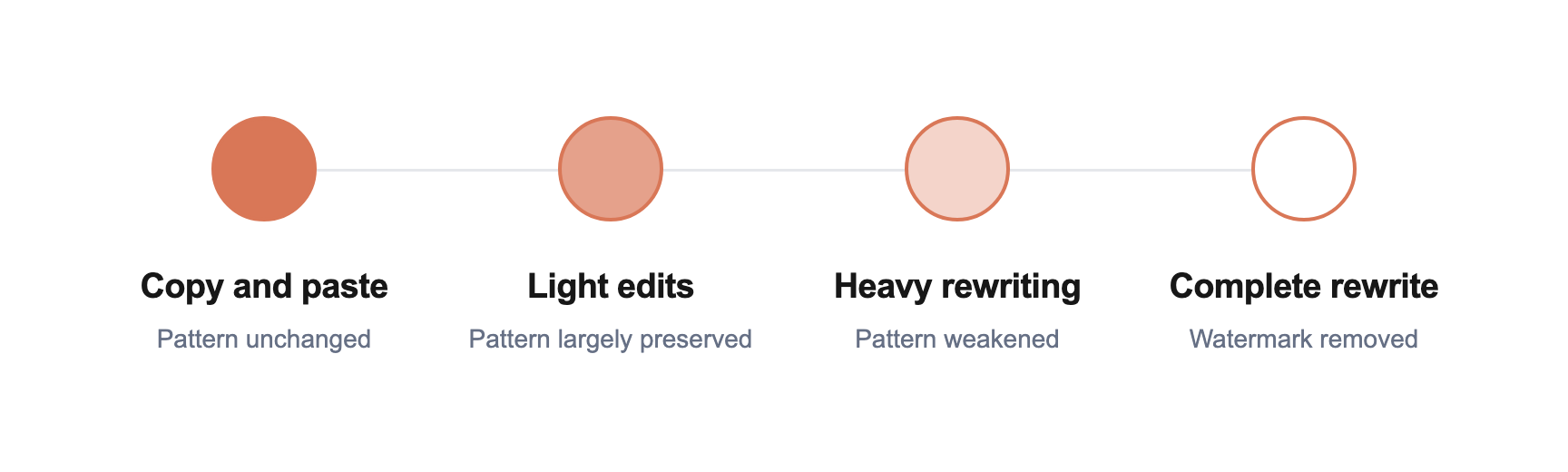
Claude's watermark is designed to remain with the writing when it is copied and pasted. Moving the response into Google Docs, Microsoft Word, Canvas, an email, or another text editor does not create a new sequence of words, so the underlying pattern remains.
Light editing may not be enough either. Correcting punctuation, deleting a sentence, or replacing several words can leave most of Claude's original token sequence unchanged. Anthropic states that light editing probably will not remove the watermark completely.
The signal becomes weaker when more of the original writing is replaced. Heavy editing, substantial paraphrasing, translation, or combining the passage with other writing may reduce the amount of detectable information. Anthropic also confirms that a complete rewrite in which the original words are replaced removes the watermark.
Watermark detection becomes more reliable as a passage gets longer. Very short responses contain fewer token choices, leaving less information for a detector to evaluate. Factual answers, proofreading, and code may also contain weaker watermarks because the model has fewer equally valid choices available without changing the correct answer.
What Does a Detected Claude Watermark Prove?
A detected watermark indicates that Claude was likely involved with the text at some point. It does not prove that Claude wrote every sentence or developed the underlying ideas.
Someone might give Claude a human-written draft and ask it to reorganize, translate, or heavily edit the writing. The final version could carry Claude's watermark even though the research, argument, and original draft came from a person. A watermark cannot distinguish between text written entirely by Claude and text that Claude substantially revised.
The opposite is also true. The absence of a detectable watermark does not prove that something was written without AI. The passage might come from an older Claude model, another AI provider, a short response, or text that was rewritten after generation.
For students, educators, publishers, and employers, the watermark should therefore be treated as one signal rather than complete evidence of authorship.
Will ChatGPT and Other AI Tools Add Watermarks?
Claude is part of a wider movement toward marking AI-generated content.
Google introduced SynthID-Text in Gemini before Anthropic adopted its own version of the technology. SynthID changes token probabilities during generation and creates a statistical pattern that Google can identify later. Google also uses related SynthID technology for images, audio, and video.
OpenAI currently uses SynthID for supported image and audio output, along with C2PA credentials for supported images. It has stated that it intends to expand provenance signals across additional formats, including text. As of August 2026, OpenAI has not announced a broad Claude-style statistical watermark across ordinary ChatGPT text responses.
Other AI providers may use a different combination of watermarks, metadata, cryptographic credentials, or detection systems. The important change is that machine-readable marking is moving from an experimental technology toward a standard feature of major generative AI platforms.
How to Remove AI Text Watermarks
Removing Claude's watermark requires fully replacing the statistical token pattern embedded within the original response. Copying the text, changing its formatting, or editing a few words does not remove the underlying watermark.
Verva's AI humanizer completely rewrites Claude-generated text while preserving its original meaning. It rebuilds the vocabulary, sentence structure, rhythm, and paragraph flow, removing Claude's original token sequence and the watermark it contains.
Verva also removes the predictable writing patterns analyzed by AI detectors. The result is natural, humanized text that bypasses GPTZero, Turnitin, Copyleaks, ZeroGPT, and other AI detection tools, leaving your writing undetectable.
Paste your Claude-generated text into Verva and use the AI humanizer to remove the watermark and bypass AI detectors in one step.
FAQ
Does Claude watermark its text?
Yes, supported Claude models embed an invisible statistical watermark within generated text. The watermark is created through the model's token choices and can indicate that Claude was involved in producing or processing a passage.
When did Claude start watermarking AI-generated text?
Anthropic publicly explained its text watermarking system on August 14, 2026. New supported Claude models will generate watermarked text, and Anthropic is working to extend watermarking to older models.
Can you see Claude's watermark?
No, the watermark is not visible when reading the response. It is a statistical pattern distributed across Claude's token choices and requires a compatible detection system and key to identify.
Does copying Claude text remove the watermark?
No, copying Claude text into another document preserves the same words and token sequence, so the watermark travels with the text.
Can GPTZero or Turnitin detect Claude's watermark?
GPTZero and Turnitin do not use Anthropic's private watermark key. They can still identify Claude-generated writing by analyzing predictability, vocabulary, sentence structure, rhythm, repetition, and other patterns associated with AI text.
Does Gemini watermark AI-generated text?
Yes, Google uses SynthID-Text to watermark text generated through the Gemini app and web experience. Claude's watermark is based on a version of the same general approach.
How do you remove Claude's watermark and bypass AI detectors?
Use Verva's AI humanizer to fully rewrite the Claude response. Verva replaces the original token sequence, removes the Claude watermark, and rewrites the broader language patterns evaluated by modern AI detectors. You can also humanize text right in your browser with the Verva Chrome extension.