A plagiarism checker is supposed to answer one simple question: how much of your writing already exists somewhere else? You paste in your essay, the tool scans the web, and you get a percentage back. But that number is only useful if it is accurate, and a lot of plagiarism checkers get it wrong.
They usually fail in one of two ways. Some miss copied text, so a draft looks safe when it is not. Others flag original writing as plagiarism, so you end up rewriting sentences that were already yours. For students, both mistakes matter. A missed match can turn into an academic integrity case, and a false flag can make you doubt work you wrote yourself.
Plagiarism is also more common than most people think. In surveys of more than 70,000 high school students, 58% admitted to plagiarism, which is why schools take these reports so seriously.
So instead of comparing features, we tested accuracy. We ran the same texts through three popular plagiarism checkers, Verva, GPTZero, and Pangram, and compared every score to the real amount of copied writing in the text.
How We Tested the Plagiarism Checkers
To measure accuracy, every text in the test needed a known answer. We built a test set where the exact share of copied writing was known for each text, so every plagiarism score could be checked against the correct result.
We used 200 texts split into four groups:
- 100 fully copied texts. Passages copied word for word from online sources, including Wikipedia, government websites, open-access research papers, and public-domain books. 15 of these were in German, Spanish, French, Italian, and Portuguese. The correct score is 100%.
- 40 partly copied texts. Original writing mixed with copied passages. On average, about 47% of each text was copied.
- 20 lightly edited copies. Copied passages with some words changed, sentences reordered, or phrases reworded, the way people often edit copied text before submitting it.
- 40 original texts. Writing that does not exist anywhere online. The correct score is 0%.
For every text, we compared the plagiarism score each tool returned to the real share of copied writing. Every tool got the exact same texts, and we used each tool's default settings.
Plagiarism Checker Accuracy Comparison
The table below shows each tool's average score for every group of texts.
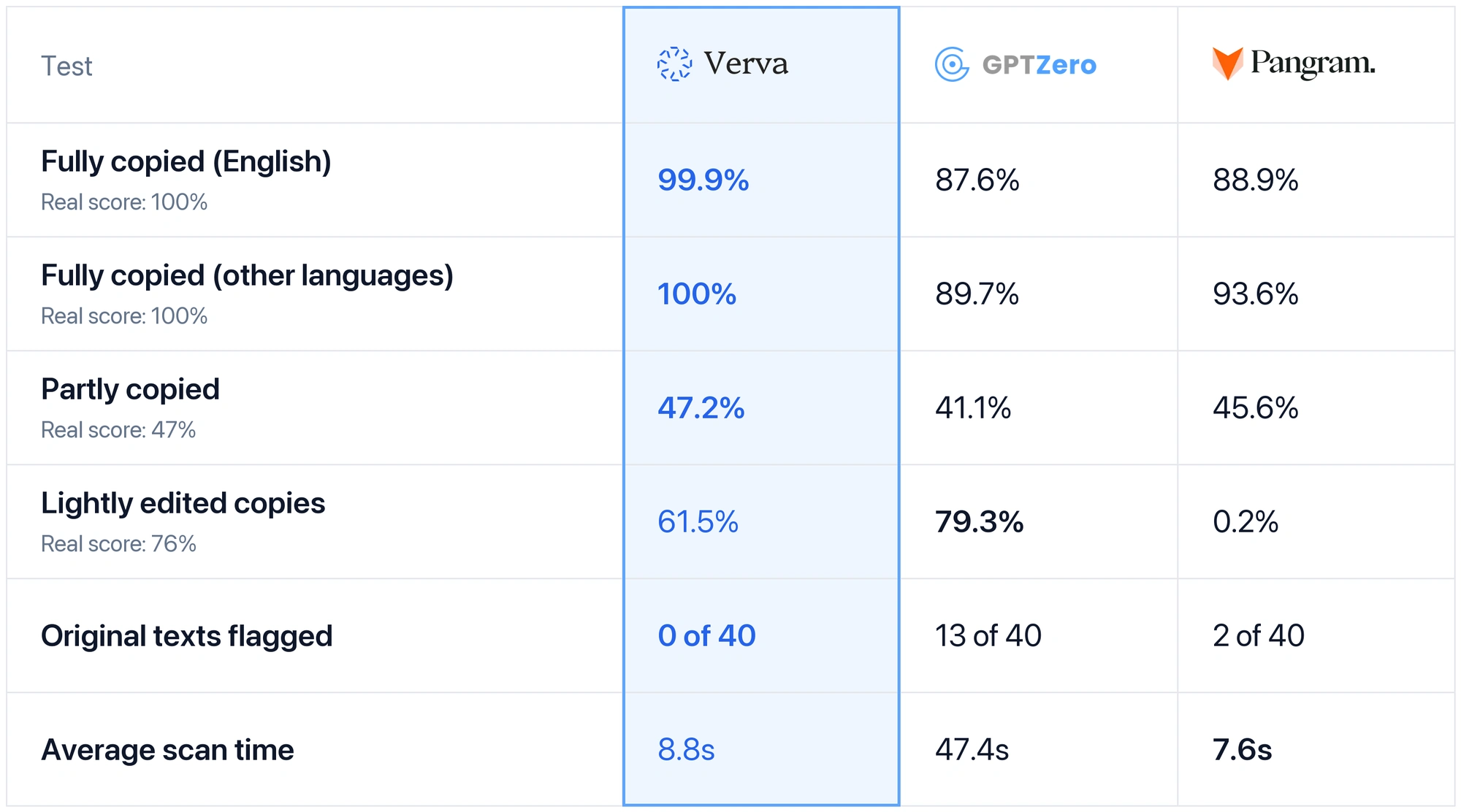
99.9% of fully copied text caught by Verva, with zero false flags on original writing.
The most accurate plagiarism checker in this test was Verva's plagiarism checker. It came closest to the real score on fully copied, partly copied, and non-English text, and it did not falsely flag a single original text. GPTZero and Pangram scored the same fully copied English texts at 87.6% and 88.9%.
Results by Tool
Here is how each plagiarism checker performed across the four groups of texts, along with what it does well and where it falls short.
Verva
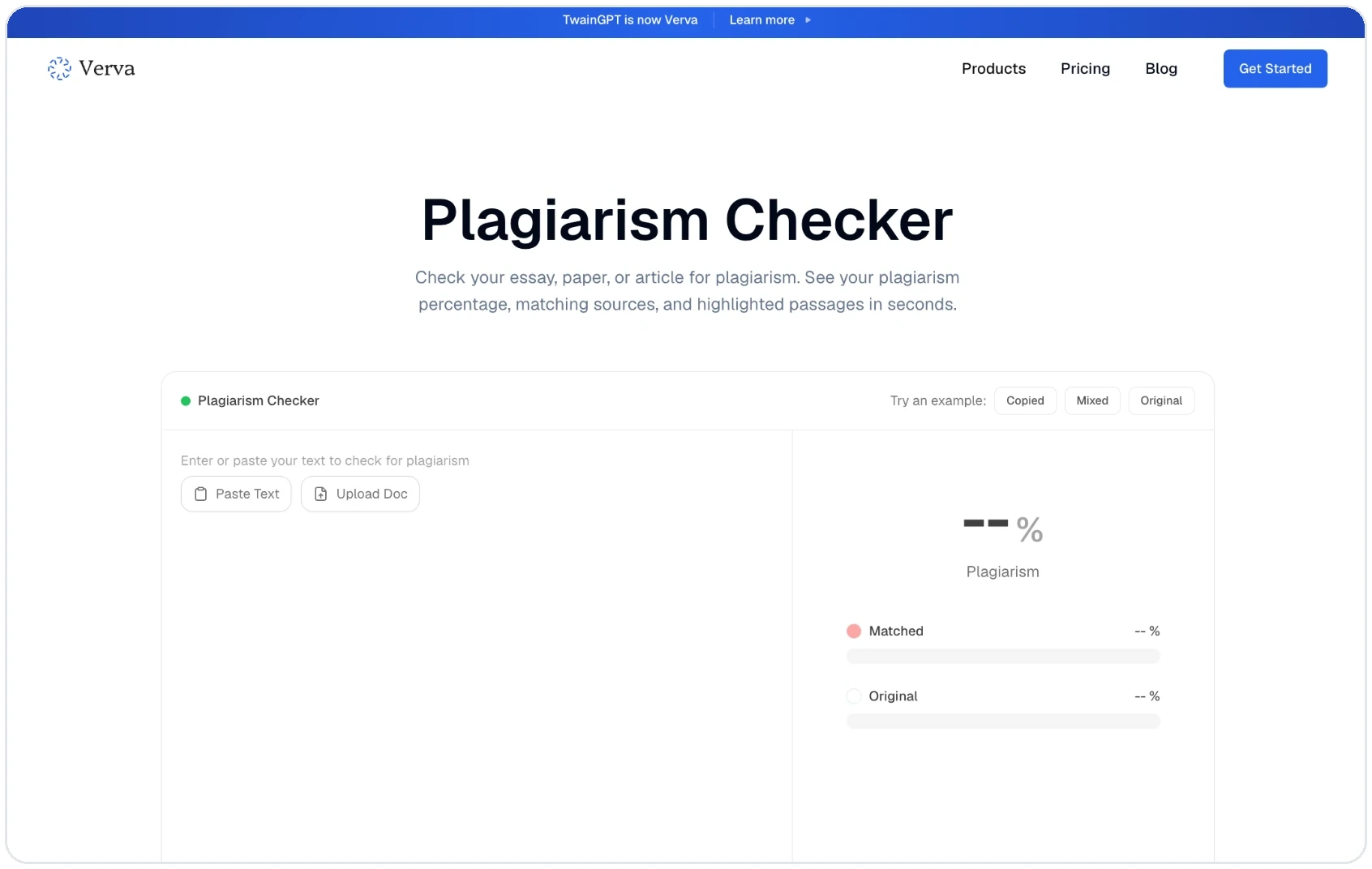
Verva is the most accurate plagiarism checker we tested. The Verva plagiarism checker scored fully copied text at 99.9% in English and 100% in other languages. On partly copied text, where the real answer was about 47%, it averaged 47.2%. It also scored 0% on all 40 original texts, so no original writing was flagged as plagiarism.
Verva also makes the results easy to act on. It highlights exactly which sentences matched, lists each source with how much of your writing it matches, and lets you open a source with the matching text already highlighted, which makes it easy to check the match yourself and add a citation. Its one weak spot was lightly edited copies, where it scored 61.5% against a real score of 76%.
GPTZero
GPTZero is best known as an AI detector, but it also includes a plagiarism checker. Its strongest result was on lightly edited copies, where it averaged 79.3% against a real score of 76%, the best result in that group. GPTZero was the most willing of the three tools to flag text that had been reworded.
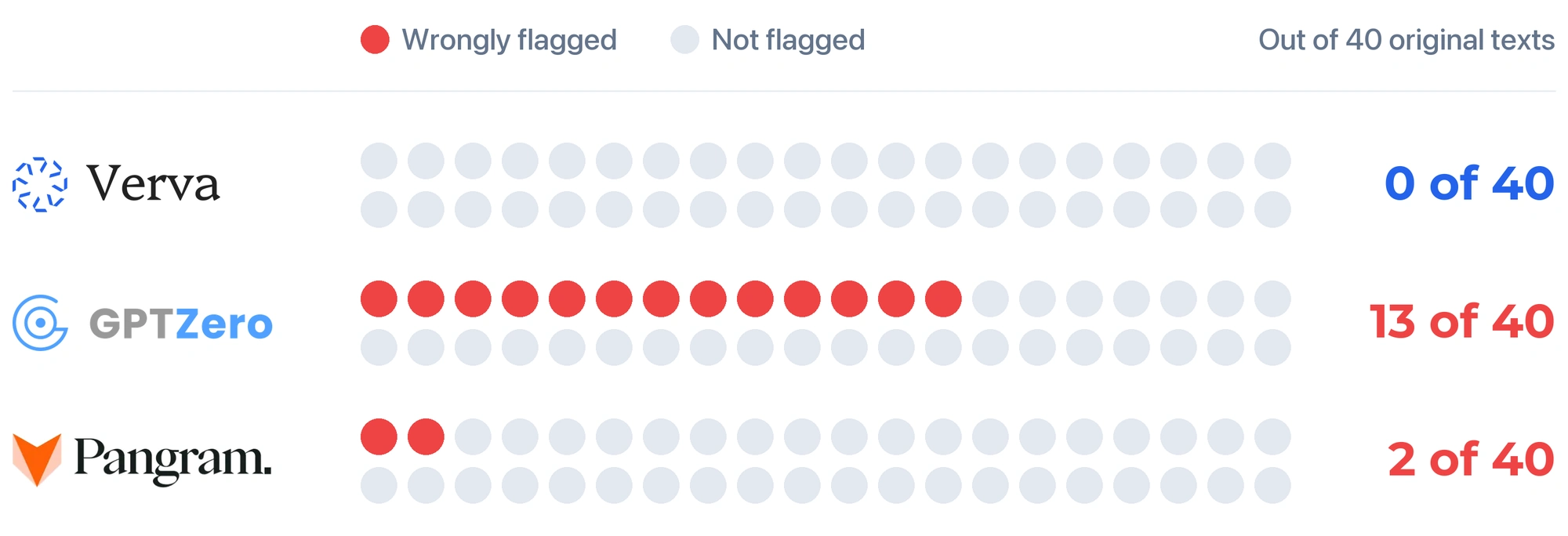
That same sensitivity is also its biggest problem. GPTZero flagged 13 of 40 original texts at 10% or more, about one in three, even though none of them were copied. It also missed part of the fully copied text, averaging 87.6% where the real score was 100%, and it was the slowest tool in the test at about 47 seconds per scan.
Pangram
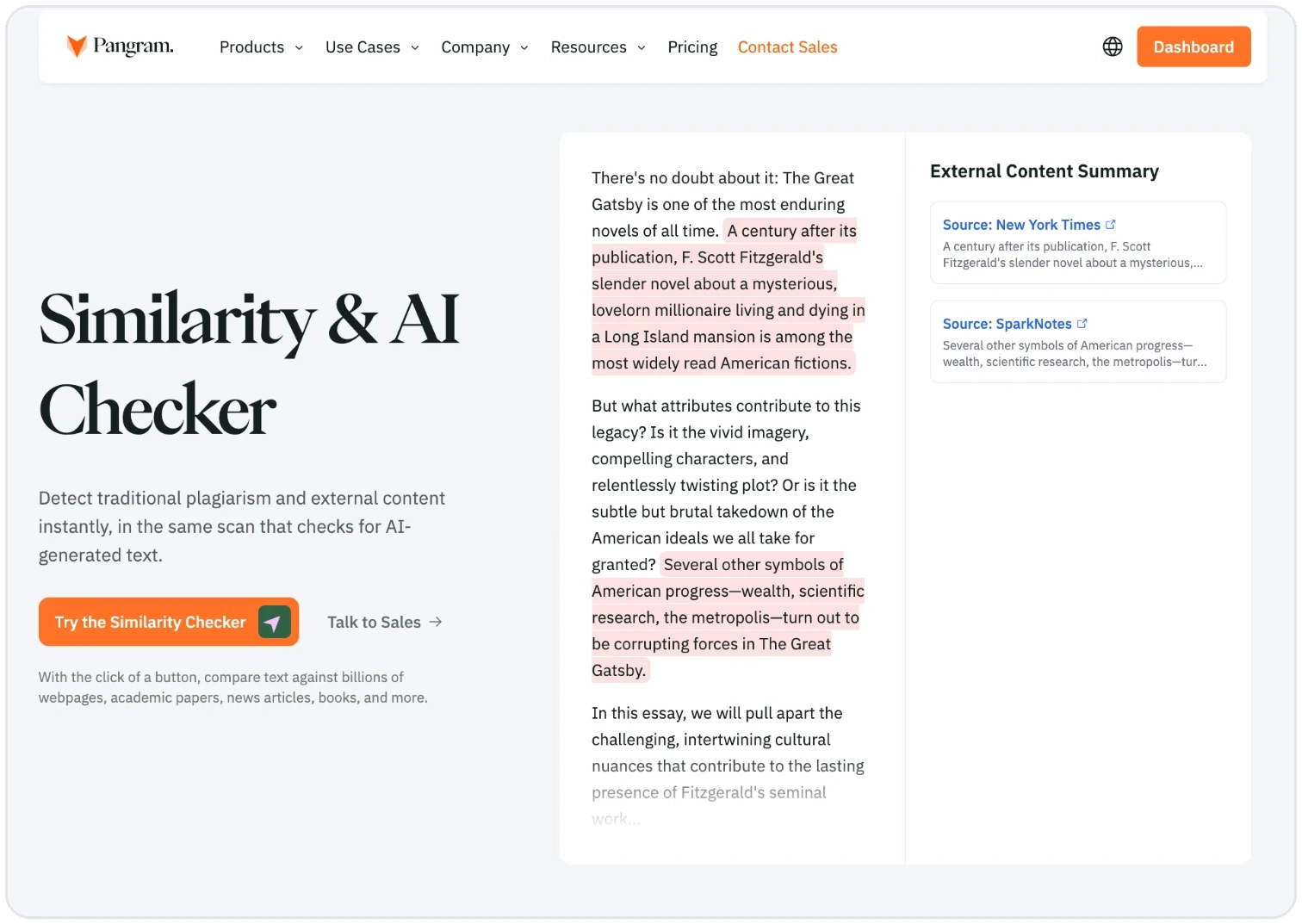
Pangram is also known mainly as an AI detector, and it offers plagiarism checking as well. It was the fastest tool in the test at 7.6 seconds per scan, and it rarely flagged original writing, with only 2 of 40 original texts scored at 10% or more.
Its biggest weakness was edited text. On lightly edited copies, Pangram averaged just 0.2%, which means it missed almost all of the copied writing once a few words were changed. It also scored fully copied English text at 88.9% instead of 100%.
Key Findings
All three plagiarism checkers caught most word-for-word copying, but the details made a big difference.
Exact copies are not always caught. GPTZero and Pangram both scored fully copied text around 88%, which means about 12% of the copied text went unflagged. Verva found nearly all of it, in English and in other languages.
False flags are a real problem. A plagiarism checker that flags original writing makes every report harder to trust. GPTZero flagged 13 of 40 original texts, Pangram flagged 2, and Verva flagged none.
Edited text is the hardest test for every tool. When copied text is reworded, plagiarism checkers have less to match. GPTZero did best here, Verva caught most of it, and Pangram caught almost none. This matches independent research: in a 2020 study, academic integrity researchers tested 15 plagiarism checkers and found that none caught all plagiarism, with results dropping once text was paraphrased or translated. If you have reworded a source, the safest fix is still to cite it.
Mixed writing needs a precise score. Most real drafts are not 0% or 100% copied. On partly copied text, where the real answer was 47%, Verva averaged 47.2%, Pangram averaged 45.6%, and GPTZero averaged 41.1%.
How to Check Your Work Before Submitting
A plagiarism check is most useful before you submit, while you can still fix things. Start by running your full draft through a plagiarism checker, quotes and reference list included. Many checkers, including Verva, can leave quotes and references out of the score. Then open each match and look at the source to decide whether it needs a citation, quotation marks, or a rewrite in your own words.
Cite anything you used, even if you reworded it, because paraphrasing a source without citing it can still count as plagiarism. Once you have made your changes, run the check again to make sure nothing was missed.
If you also need to check whether your writing reads as AI-generated, use an AI detector. AI detection and plagiarism checking look for different things, so a draft can pass one and fail the other. We explain the difference in our guide on AI detectors vs plagiarism checkers.
Final Verdict
Based on this test, Verva is the most accurate plagiarism checker. It caught nearly all fully copied text in English and other languages, gave a precise score on partly copied text, and did not flag a single original text as plagiarism.
GPTZero was the best at catching lightly edited copies, but it flagged about a third of original texts. Pangram was the fastest, but it missed almost all edited text. If you want a plagiarism score you can trust, start with Verva's plagiarism checker.
FAQ
Which plagiarism checker is the most accurate?
The most accurate plagiarism checker is the one whose score stays closest to the real amount of copied text without flagging original writing. Of the tools we compared, Verva came closest, catching nearly all fully copied text while flagging no original writing.
Can a plagiarism checker flag original writing?
Yes, plagiarism checkers can flag original writing when it shares common phrases, standard definitions, or short matches with existing sources. This is called a false positive, and it is more common with some tools than others: in our test, GPTZero flagged 13 of 40 original texts, while Verva flagged none. If your writing gets flagged, open each match and check whether it really comes from that source before you rewrite anything.
What plagiarism percentage is acceptable?
It depends on your school, teacher, or publisher. A low score is usually fine when the matches are properly quoted and cited. What matters most is not the number itself, but whether each match is cited correctly.
Do plagiarism checkers check other languages?
Many plagiarism checkers support other languages, but results are often less reliable outside English because fewer sources are searched. If you write in another language, use a checker that searches sources in that language. Verva's plagiarism checker works in 100+ languages, including Spanish, French, German, Portuguese, Italian, Russian, Arabic, Chinese, and Japanese.
Is a plagiarism checker the same as an AI detector?
No, a plagiarism checker looks for text that matches existing sources, while an AI detector looks for patterns that suggest text was generated by AI. Original AI-generated writing can pass a plagiarism check and still be flagged by an AI detector.