You have a paragraph you want to check, but some AI detectors ask for more text before they will scan it. How much you need depends on the tool. Some count words, while others count characters.
Here are the minimums for some of the most popular AI detectors. Word counts and character counts are shown as each tool uses them.
| AI detector | Minimum |
|---|---|
| GPTZero | 250 characters |
| ZeroGPT | No minimum |
| QuillBot | 40 words |
| Grammarly | 40 words |
| Turnitin | 300 words |
| Verva | 50 words |
| Pangram | 50 words |
| Sapling | 150 characters |
| Copyleaks | 350 characters |
| Originality AI | 100 words |
A tool may accept text at its minimum while still recommending a longer sample. ZeroGPT warns on very short scans, and QuillBot accepts 40 words but recommends 80.
Minimums by AI Detector
GPTZero: 250 characters

GPTZero says its dashboard has a 250-character minimum, which it estimates at about 50 words. That word estimate is only a rough conversion. A long technical word, a short sentence, spaces, and punctuation all affect character count differently.
ZeroGPT: No minimum

ZeroGPT accepts any non-empty text, but in our check it displayed a “Please input more text for a more accurate result” warning at 250 characters or fewer. The warning disappeared at 251 characters. It is a recommendation, not a submission minimum.
QuillBot: 40 words

QuillBot's AI detector accepted 40 words in our check, making that the practical submission minimum. QuillBot recommends at least 80 words for more reliable results.
Grammarly: 40 words

Grammarly's public AI detector requires at least 40 words before it will scan the text. Shorter inputs need more writing before the checker can return a result.
Turnitin: 300 words

Turnitin requires at least 300 words of qualifying text to generate an AI Writing Report. A file can contain 300 words but still lack enough eligible writing for the report. Turnitin has file, language, and maximum-length requirements, so meeting the word count alone does not guarantee a report.
Verva: 50 words

Verva's AI detector requires at least 50 words to run a scan. For ordinary writing, the 50-word requirement is the easiest number to use when preparing a scan.
Pangram: 50 words

Pangram requires at least 50 words for a scan. Shorter input does not give its detector enough context to analyze writing patterns reliably.
Sapling: 150 characters

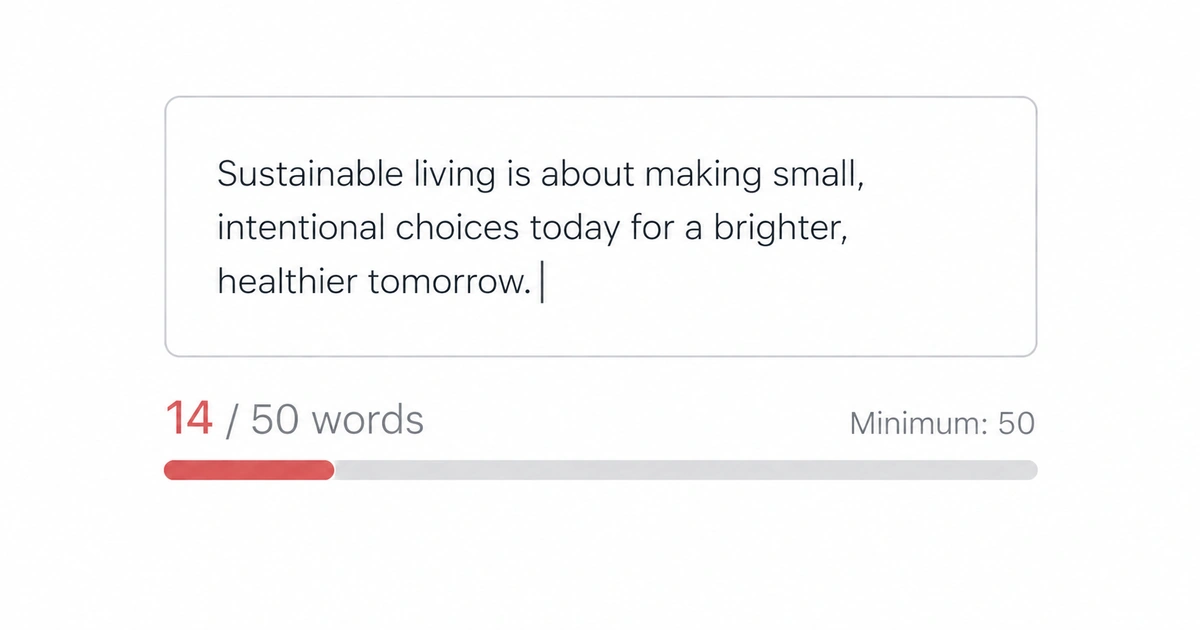
Sapling's detector accepted our 150-character sample even though it contained only 14 words. Its warning says “Try at least 50 words,” but the checker allowed this shorter submission. The practical minimum in the interface we tested is 150 characters.
Copyleaks: 350 characters

Copyleaks' AI detector requires at least 350 characters before it will run a scan. Because it counts characters rather than words, the number of words needed can vary depending on their length.
Originality AI: 100 words

Originality AI's detector will not let you submit text until it reaches at least 100 words. If your excerpt is shorter, include more of the original writing before running the scan.
Why AI Detectors Have Minimum Word Counts
AI detectors look for patterns across a piece of writing, such as word choice, sentence structure, and how those features vary from one sentence to the next. A few words or a single sentence give the model very little context. A phrase that looks typical of AI writing could also appear in something a person wrote. With more text, the detector has more examples to assess instead of relying heavily on one short stretch.
That is why many tools require a minimum length before they return a score. Each company sets its own threshold, and some count words while others count characters. ZeroGPT accepts short text, but warns that very short scans may be less accurate.
Is the Minimum Enough for a Useful Result?
The minimum answers whether a detector will run, not whether the shortest accepted input is the best one to scan. That is why QuillBot and ZeroGPT encourage longer submissions even when their systems can process shorter ones.
If you have a complete piece of writing, scan the complete text when the tool allows it. If you only have a short excerpt, the score applies to that excerpt, not automatically to the document it came from.
Words and characters are also different units. There is no exact conversion that makes a 250-character rule equivalent to a 50-word rule for every piece of writing. For a quick check, use the counter built into the detector rather than an estimated conversion.
FAQ
Can an AI detector check a single sentence?
Some may accept one, but many of the tools above will reject it for being too short. Even when a sentence can be submitted, it provides limited context. Check a longer section if one is available.
Does meeting the minimum word count make a result accurate?
No. The minimum only allows the scan to run. The writing's length, language, style, and degree of editing can still affect the result. A detector score is more useful when there is enough text to analyze and when it is considered alongside other information about the writing.
Why does Turnitin require more text than other AI detectors?
Turnitin's AI Writing Report is built around longer writing submissions and requires 300 qualifying words. Other tools offer different products and set different input limits. The minimums are product rules, not a ranking of which detector is more accurate.
What if my text is below the minimum word count?
If you have more of the original writing, include it. Don't add unrelated text just to meet the minimum; that would change what the detector is analyzing.
How can I bypass AI detectors?
Rewriting AI-generated text with more natural wording and varied sentence structure can change how detectors evaluate it. Verva's AI humanizer does this for you, helping the text sound human and bypass AI detectors while preserving its meaning.